
Hip and knee replacement Gold Coast
Joint replacement resurfaces a worn hip or knee with an artificial bearing surface, restoring smooth movement and relieving the pain of advanced arthritis. Dr Jason Tsung performs hip and knee replacement using robotic-assisted planning and minimally invasive techniques, and has performed over 1,000 hip and knee replacements.
Written and reviewed by Dr Jason Tsung, FRACS (Orth) · Last reviewed July 2026
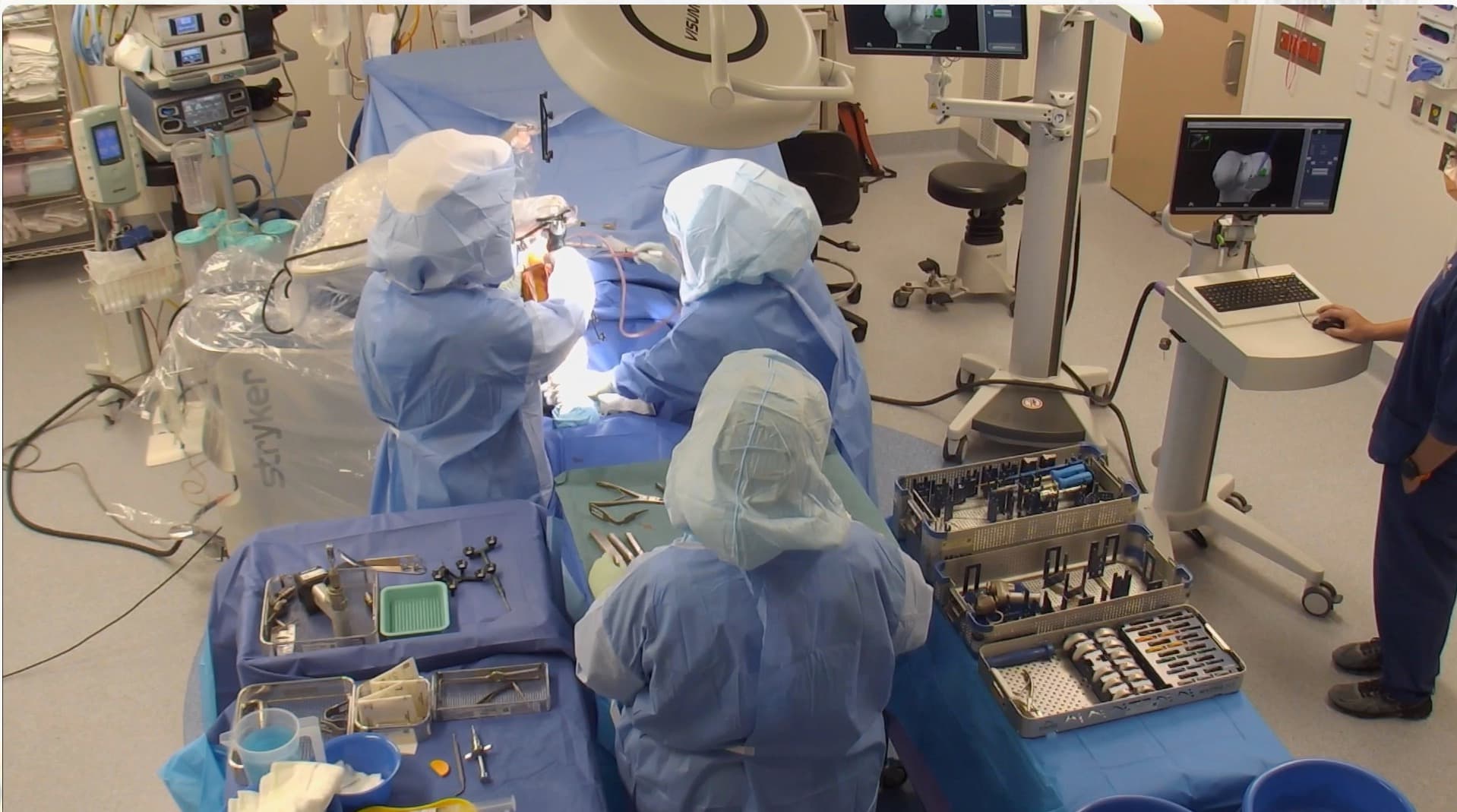
When joint replacement is the right step
Joint replacement is rarely the first step. It's usually considered when arthritis pain no longer responds to non-surgical care, when it interferes with walking, working, or sleep, and physiotherapy, weight management and medication aren't enough. It isn't right for everyone, and the decision is yours. If you haven't worked through non-surgical options yet, start with hip and knee arthritis management.
How Dr Tsung approaches surgery
Three things shape how your operation is planned and performed.
Robotic-assisted planning. Dr Tsung uses the Mako robotic-arm system to plan the implant from a CT scan of your joint and position it accurately during surgery. He has used it since 2016. More on robotic-assisted joint replacement.
Minimally invasive approaches. For the hip, the direct superior approach spares muscle and tendon that traditional approaches divide. For the knee, an anterolateral skin incision is designed to avoid the nerve that causes the common patch of numbness after knee replacement. Both aim to ease the first weeks of recovery.
Enhanced recovery. Dr Tsung follows an enhanced recovery after surgery (ERAS) pathway: modern pain control, movement on the day of surgery, and a structured plan, supported by a prehabilitation program before the operation.
The procedures
- Hip replacement Gold Coast, including the direct superior, minimally invasive approach, and robotic hip replacement
- Knee replacement, total and partial, with functional alignment and robotic knee replacement
- Robotic-assisted joint replacement, how the Mako system supports accurate planning and placement
- Revision joint replacement, repairing or replacing a previous hip or knee replacement that has worn, loosened or become infected
What to expect
Most people get substantial, lasting relief from pain and a real improvement in mobility. Recovery is gradual. The early-recovery benefits of minimally invasive techniques are real but tend to even out over the first few months, and long-term results are similar across surgical approaches.¹ Modern hip and knee replacements are durable, and Australian registry data show that around 95% are still working at ten years.² Like any surgery, joint replacement carries risks, and individual results vary. Dr Tsung will go through what's likely in your case.
Common questions
Do I need a joint replacement, or are there other options first?
Joint replacement is usually considered only once arthritis pain no longer responds to non-surgical care. For most people the first steps are activity changes, weight management, exercise or physiotherapy and medication, and many manage their symptoms this way for years. Surgery becomes an option when pain interferes with walking, working or sleep and those measures aren't enough. The decision is yours, and Dr Tsung will talk through where you are. If you haven't worked through non-surgical options yet, start with hip and knee arthritis management.
What is robotic-assisted joint replacement?
Robotic-assisted surgery uses a CT scan of your joint to plan the size and position of the implant before the operation, and helps position it accurately during surgery. Dr Tsung uses the Mako robotic-arm system and has done so since 2016. The surgeon performs the operation throughout; the robotic arm supports the plan rather than replacing the surgeon. More on robotic-assisted joint replacement.
How long do hip and knee replacements last?
Most modern hip and knee replacements are still working well ten years after surgery, and many last considerably longer. Australian registry data show that around 95% are still functioning at ten years. How long any individual joint lasts depends on factors like your age, weight, activity level and the implant used, and a small number need revision surgery over time.
How long is recovery after joint replacement?
Recovery is gradual and differs between people and between the hip and the knee. Most people are up and walking with aids on the day of surgery or the day after, and Dr Tsung follows an enhanced recovery (ERAS) pathway to get you moving early. The early-recovery benefits of minimally invasive techniques are real but tend to even out over the first few months. Many people return to driving and lighter work within several weeks, with fuller recovery continuing over six to twelve months.
What are the risks of joint replacement?
Joint replacement relieves pain and improves mobility for most people, and serious complications are uncommon, but like any major surgery it carries risks. These include infection, blood clots in the leg or lung, stiffness, loosening or wear over many years, nerve or blood-vessel injury and fracture, with ongoing pain in a small number of cases. A replaced joint also won't feel identical to a natural one. Dr Tsung discusses the risks that apply to you, and individual results vary.
Book or refer
To see Dr Tsung you’ll need a referral from your GP or another specialist. Call reception on (07) 5676 9930 to book your first appointment, or email hello@sgco.au. New patients can pre-register online before the visit; the form prepares your records and does not book an appointment. For costs, see fees and health funds.
References
- Van Dooren B, et al. No clinically relevant difference in patient-reported outcomes between the direct superior approach and the posterolateral or anterior approach for primary total hip arthroplasty: analysis of 37,976 primary hip arthroplasties in the Dutch Arthroplasty Registry. Acta Orthopaedica. 2023;94:543–549.
- Australian Orthopaedic Association National Joint Replacement Registry (AOANJRR). Hip, Knee & Shoulder Arthroplasty: 2025 Annual Report. Adelaide: AOA; 2025.