
Partial knee replacement Gold Coast
A partial (unicompartmental) knee replacement resurfaces only the one worn part of the knee and leaves the healthy cartilage and the knee's own ligaments in place. For a well-selected knee it is a smaller operation than a total knee replacement, with a quicker recovery. Not everyone is suitable, and which operation fits depends on where the arthritis is and the state of the rest of the knee.
Written and reviewed by Dr Jason Tsung, FRACS (Orth) · Last reviewed July 2026
What is a partial knee replacement?
The knee has three compartments: the inner (medial) side, the outer (lateral) side, and the kneecap (patellofemoral) joint. When arthritis wears out only one of them, a partial knee replacement resurfaces just that compartment with metal and plastic components and leaves the rest of the knee, including its healthy cartilage and the cruciate ligaments, untouched. Most partial knee replacements are done on the inner side, which is the part most commonly worn out.
Because most of the knee is left alone, it is a smaller operation than a total knee replacement, which resurfaces all of the worn surfaces. The operation usually takes around an hour, and many people go home sooner than after a total knee replacement.
Who is suitable?
A partial knee replacement is an option when the arthritis is confined to one compartment, the ligaments (in particular the anterior cruciate ligament) are intact, and the knee is not badly deformed or stiff. If the arthritis is spread across more than one compartment, the ligaments are damaged, or there is significant deformity, a total knee replacement is the better choice.
Only some people are suitable. An X-ray and an examination of the knee, sometimes with further imaging, show whether the wear is genuinely confined to one compartment. Age and weight alone do not rule it in or out. Dr Tsung will tell you honestly whether a partial knee replacement fits your knee, or whether a total knee replacement would serve you better.
The advantages
For the right knee, a partial replacement has real advantages. It is a smaller operation with less blood loss, the recovery is often quicker, and because it keeps the knee's own ligaments and healthy cartilage, the knee can feel more natural to some people. Early complication rates tend to be lower than for a total knee replacement, and more of the knee's normal movement is retained.
The trade-off
The main trade-off is the chance of needing further surgery. In large registry data, partial knee replacements are revised about twice as often as total knee replacements.¹ Trials tell a more favourable story: over ten years in TOPKAT, the largest randomised comparison of the two operations, partial and total knee replacement had similar reoperation and revision rates and similar overall results, with partial tending to have slightly fewer complications and slightly better quality of life at lower cost.²
The gap between the registry and the trial findings comes down to selection and accuracy. A partial knee replacement is less forgiving of being done in the wrong knee or positioned imperfectly. Chosen for the right patient and placed accurately, it performs very well; outside that, it is more likely to need revision. When a partial knee does need redoing, it is usually converted to a total knee replacement, which generally works well. More on how long a knee replacement lasts and on total versus partial knee replacement.
Why precision matters
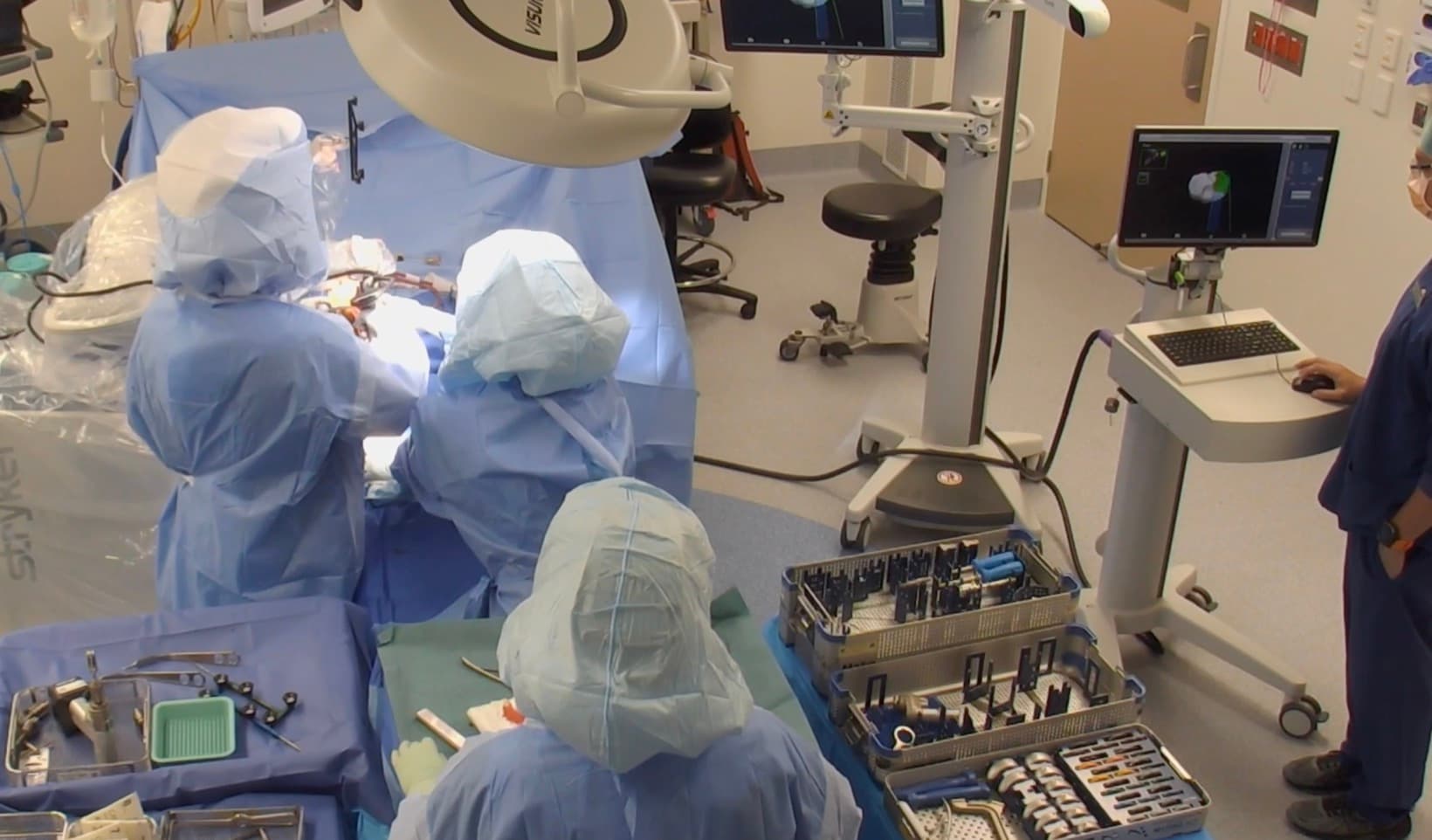
Because a partial knee replacement is less forgiving of small errors in implant position, accuracy matters, and this is where robotic assistance may help most. Dr Tsung uses the Mako system to plan and place both partial and total knee replacements from a CT scan of your knee. The plan is checked and adjusted before any bone is cut, which helps position the implant accurately for your knee. More on robotic-assisted joint replacement and robotic knee replacement.
Recovery
Recovery from a partial knee replacement is often quicker than from a total, because it is a smaller operation that keeps more of the knee intact. Most people are up and moving on the day of surgery and home within a day or two, then progress through a structured rehabilitation program over the following weeks. As with any joint replacement, the pace varies from person to person, and your plan is tailored to you. Dr Tsung follows an enhanced recovery pathway; more on enhanced recovery after surgery.
Risks
A partial knee replacement is generally safe, but like any operation it carries risks. These include infection, blood clots, stiffness, ongoing pain, progression of arthritis in the other parts of the knee, and wear or loosening of the implant over time, any of which may lead to further surgery. Dr Tsung will go through the risks that apply to your situation, alongside the likely benefits, so you can make an informed decision.
Common questions
Am I suitable for a partial knee replacement?
You may be if the arthritis is confined to one compartment of the knee, the ligaments are intact, and the knee isn't badly deformed or stiff. An X-ray and an examination decide it. If the arthritis is spread across the joint, a total knee replacement is the better choice.
Is a partial knee replacement better than a total?
Neither is better overall. A partial suits a knee with arthritis in only one compartment; a total suits the rest. The right operation is the one that matches your knee.
Does a partial knee replacement wear out faster?
In registry data it's revised about twice as often as a total knee,¹ though in trials of well-selected patients the rates are similar.² Careful selection and accurate placement matter a great deal.
Can a partial knee replacement be converted to a total later?
Yes. If a partial knee replacement wears out or fails, it's usually revised to a total knee replacement, which generally works well.
Is recovery quicker than a total knee replacement?
It often is, because it's a smaller operation that keeps more of the knee intact. Individual recovery varies, and your rehabilitation plan is tailored to you.
Book or refer
To see Dr Tsung you’ll need a referral from your GP or another specialist. Call reception on (07) 5676 9930 to book your first appointment, or email hello@sgco.au. New patients can pre-register online before the visit; the form prepares your records and does not book an appointment. For costs, see fees and health funds.
References
- Australian Orthopaedic Association National Joint Replacement Registry (AOANJRR). Hip, Knee & Shoulder Arthroplasty: 2025 Annual Report. Adelaide: AOA; 2025.
- Beard DJ, Davies LJ, Cook JA, et al. Assessing clinical and cost effectiveness of total versus partial knee replacement (TOPKAT): 10-year follow-up of a multicentre, randomised controlled trial. Lancet Rheumatology. 2025.