
The direct superior approach: minimally invasive hip replacement
Every hip replacement reaches the joint by passing through the tissues around it. How much of that tissue is disturbed affects the early part of recovery. The direct superior approach is a minimally invasive way of reaching the hip that leaves more of those structures intact, with the aim of an easier first few weeks.
Does Dr Tsung perform minimally invasive hip replacement on the Gold Coast?
Dr Jason Tsung performs hip replacement using the direct superior approach at John Flynn Private Hospital in Tugun. The direct superior approach is his usual muscle-sparing approach for suitable hip replacements, and it is commonly combined with robotic-assisted planning; more context is on the hip replacement page.
What the direct superior approach is
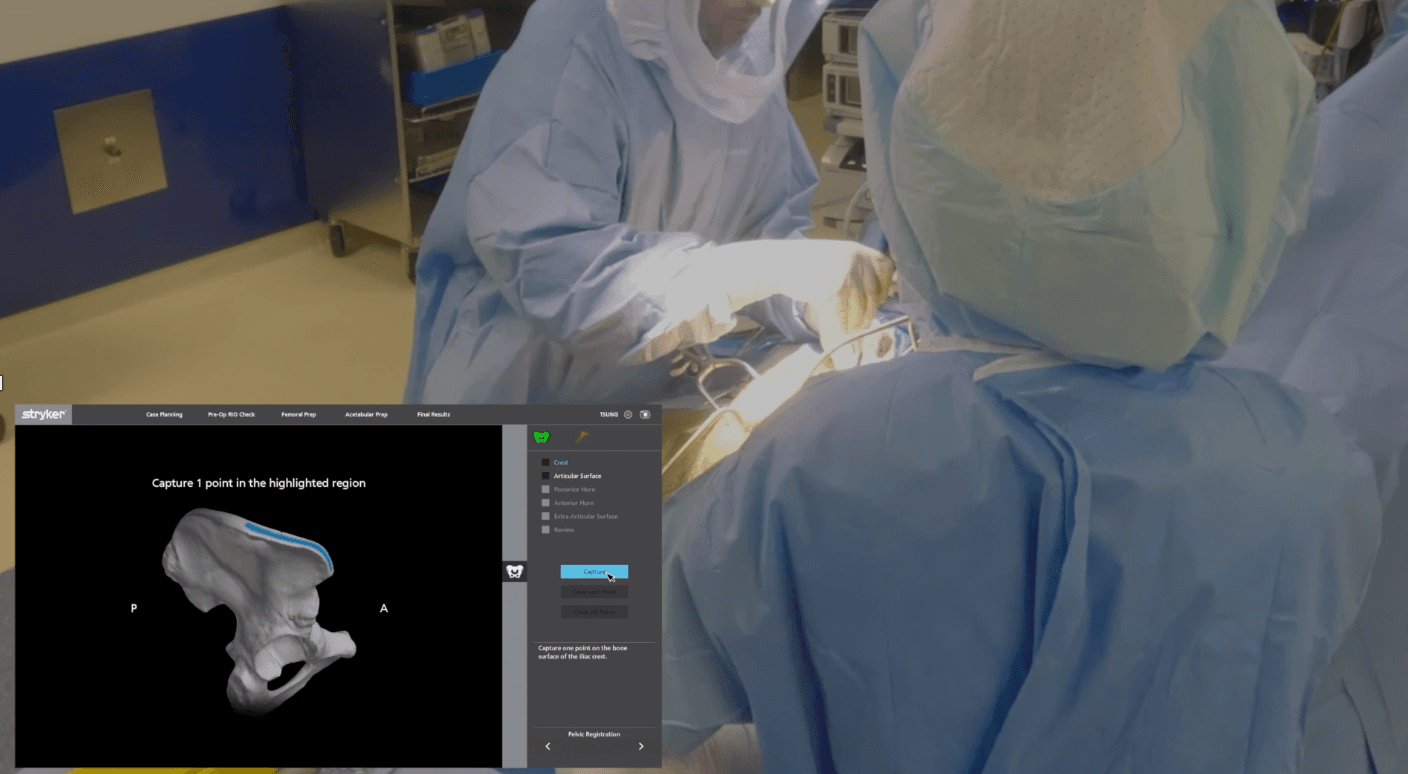
The direct superior approach is a modification of the standard posterior approach to the hip. It reaches the joint from above, through a smaller incision, and leaves two structures intact that a traditional posterior approach usually divides: the iliotibial band, a strong band of tissue running down the outside of the thigh, and the quadratus femoris, one of the deep muscles at the back of the hip. The implant that goes in, and the way it's fitted, are the same as a standard hip replacement. What changes is how the surgeon gets to the joint. It's the approach Dr Tsung has used as his primary technique for hip replacement since 2015, combined with robotic-assisted planning; more on robotic hip replacement.
Where the incision is
The greater trochanter is the bony bump you can feel on the outer side of your hip. In the direct superior approach, the incision begins at the upper, rear corner of that bump and runs at an angle, upward and slightly back toward the buttock. It's short, usually around 8 to 12 centimetres.
Two things about its position matter. First, it sits higher and further back than the incision used for a traditional hip replacement, which is longer and extends further down the outer thigh. Second, its position lets Dr Tsung reach the joint while leaving the iliotibial band intact, the strong band running down the outside of the thigh that a traditional approach usually has to divide.⁶
Why sparing those structures may help
The iliotibial band and the muscles at the back of the hip help stabilise and move the joint. Leaving them intact means less of the hip's supporting tissue is cut and repaired, which is the likely reason studies report a smoother early recovery. It's a difference in surgical access, not in the replacement itself, so it changes the first weeks rather than the eventual result.
Sparing those structures also shapes recovery in a practical way. Hip replacement has traditionally come with a list of formal precautions, movements you must avoid for several weeks to protect the joint. Dr Tsung doesn't use them. Because the muscle and tendon at the back of the hip are left intact, the advice is simply to be sensible and take it easy for the first six weeks while everything heals.
What the research shows
Compared with the standard posterior approach, studies of the direct superior approach report:
- a shorter hospital stay, by around half a day to a day¹,²
- less blood loss during surgery, and a smaller incision¹,²
- lower pain and less opioid use in the first days after surgery³
- reaching early movement milestones sooner, and a higher chance of going straight home rather than to a rehabilitation facility⁴,²
These advantages are concentrated in the early weeks. By three to twelve months, patient-reported outcomes are similar whether the hip was replaced through the direct superior approach or a standard approach, including in a Dutch registry analysis of nearly 38,000 hip replacements.⁵ Complication rates, including the risk of dislocation, are comparable.⁶ The evidence base for the approach is also smaller than for long-established techniques and comes mostly from observational studies, so these findings are best read as consistent rather than proven.
Is it right for me?
The direct superior approach suits many hip replacements, but not all. A complex hip, significant deformity, or previous surgery may call for a standard approach to keep the joint stable over the long term. Dr Tsung will assess your hip and advise which approach fits it. As with any surgery, results vary between individuals, and the approach doesn't change the risks that come with hip replacement itself.
Common questions
Is a direct superior approach hip replacement different from a standard hip replacement?
No. Only the way the surgeon reaches the joint changes. The implant and how it’s fitted are the same as a standard hip replacement.
Will I recover faster?
Studies report a shorter hospital stay and a smoother early recovery on average, but these benefits are concentrated in the first weeks and even out over the following months.¹,⁵ Individual results vary.
Does it last longer than a standard hip replacement?
There’s no evidence that it does. Long-term results are similar across surgical approaches.⁵
Speak to Dr Tsung
Dr Tsung performs hip replacement and uses the direct superior approach for many patients. It has been his primary approach since 2015, for both first-time (primary) hip replacements and selected revision procedures. To discuss your hip, you'll need a referral from your GP or another specialist. Call reception on (07) 5676 9930 to book your first appointment, or email hello@sgco.au. New patients can pre-register online before the visit; the form prepares your records and does not book an appointment. More on hip replacement.
References
- Yousef MAA, et al. Direct superior approach versus posterior approach in total hip arthroplasty: a systematic review and meta-analysis. Journal of Orthopaedics. 2025;67:1–9.
- Lu Y, Xiao H, Xue F. The efficacy and safety of the direct superior approach (DSA) for total hip arthroplasty: a systematic review and meta-analysis. Journal of Orthopaedic Surgery and Research. 2023;18:764.
- Hong S, et al. Postoperative patient-reported pain and opioid consumption after total hip arthroplasty: a comparison of the direct superior and posterior approaches. Journal of Clinical Medicine. 2025;14.
- Kenanidis E, et al. Earlier functional recovery and discharge from hospital for THA patients operated on via the direct superior compared to the standard posterior approach. Hip International. 2022;33:620–627.
- Van Dooren B, et al. No clinically relevant difference in patient-reported outcomes between the direct superior approach and the posterolateral or anterior approach for primary total hip arthroplasty: analysis of 37,976 primary hip arthroplasties in the Dutch Arthroplasty Registry. Acta Orthopaedica. 2023;94:543–549.
- Van Dooren B, et al. The direct superior approach in total hip arthroplasty. JBJS Reviews. 2024;12.