
Meniscus tears
The meniscus is the knee’s shock absorber: two C-shaped pads of cartilage that sit between the thigh bone and shin bone, cushioning the joint and helping it stay stable. A torn meniscus is one of the most common knee problems, and how it’s best treated depends a lot on which kind of tear you have.
Written and reviewed by Dr Jason Tsung, FRACS (Orth) · Last reviewed July 2026
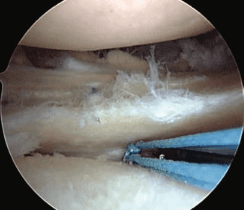
Two kinds of tear
Degenerative tears happen as the meniscus weakens with age. They often appear with little or no injury, sometimes just from a squat or twisting to stand up, and they usually go hand in hand with early wear (osteoarthritis) in the knee. This is the common kind in people past their forties.
Acute tears happen from a specific injury, a sharp twist or pivot on a planted foot, more often in younger, active people. A larger fragment can sometimes flip into the joint and physically block the knee from straightening. Acute sports injuries, including ACL tears, are covered on sports knee injuries.
Symptoms
A meniscus tear can cause pain along the joint line, swelling, a catching or clicking feeling, and a sense that the knee might give way. It can be hard to fully straighten or bend. It's worth knowing that many degenerative tears cause few or no symptoms and are found by chance on a scan done for another reason, so a tear seen on MRI isn't always the cause of the pain.
How it's diagnosed
Dr Tsung will ask how the problem started, examine the knee, and look at your imaging. An X-ray shows the state of the joint and any arthritis; an MRI scan shows the meniscus itself. The findings are read alongside your symptoms, not on their own.
Treating a degenerative tear
For degenerative tears, the kind tied to age and wear, the evidence is clear and perhaps surprising. In high-quality trials, keyhole surgery to trim the torn meniscus usually worked no better than exercise-based treatment. A sham-controlled trial in patients with a degenerative tear and no arthritis found surgery was no better than a placebo operation,¹ and a trial in patients with a tear and arthritis found surgery was no better than physiotherapy.² On that evidence, an expert guideline recommends against keyhole surgery for nearly all degenerative knee problems.³
So a degenerative meniscus tear is generally managed the same way as knee arthritis: exercise and strengthening, managing load and weight, time, and simple pain relief. Most settle with this approach. More on arthritis management.
This holds for the aches and the occasional click of a worn knee, which on their own aren't a reliable reason for surgery. Genuine, consistent mechanical symptoms are a different matter, covered below.
When surgery helps
Surgery has a clearer role in three situations. The first is a knee that is truly locked, where a torn fragment is physically blocking the knee from straightening; this needs urgent arthroscopy to release or trim the fragment and restore movement. The second is a knee with genuine, consistent mechanical symptoms: a tear that reliably catches, or makes the knee give way when it twists or pivots, so the knee can't be trusted. That points to a mechanically unstable tear, which is different from the vague aches and occasional clicks of a worn knee, and a scope can help. The third is an acute tear in a younger knee, particularly one that may be repairable.
Where a tear can be stitched back together (a repair) rather than trimmed away, that's usually the better option, because it preserves the meniscus.
Why we try to save the meniscus
The meniscus protects the joint surfaces, and removing part of it can raise the long-term risk of arthritis in that knee.⁴ That's why the aim, wherever possible, is to preserve or repair the meniscus rather than remove it, and why surgery isn't the default for a tear that isn't causing a mechanical problem.
The right plan for you
It comes down to the kind of tear, your age, the state of the rest of the knee, and what the knee is actually doing. After examining the knee and reviewing your imaging, Dr Tsung will explain whether yours is likely to settle with non-surgical care or whether surgery has something to offer, and why.
Common questions
Does a torn meniscus always need surgery?
No. Most degenerative tears are treated without an operation, with exercise-based care, and surgery often adds nothing for that kind of tear.¹ ² ³
My knee catches and clicks. Doesn't that mean I need surgery?
Not always. The occasional click of a worn knee isn't on its own a reason to operate, and trimming the meniscus often won't relieve it. But a knee that consistently catches or can't be trusted to twist without giving way can have an unstable tear that benefits from a scope, and a knee that is truly locked and can't straighten needs urgent assessment.
What's the difference between a repair and a trim?
A repair stitches the torn meniscus back together; a trim (partial meniscectomy) removes the torn part. A repair preserves the meniscus and is preferred where the tear allows it.
Will an untreated tear ruin my knee?
A degenerative tear is part of the knee's wear rather than a separate emergency, and managing it like arthritis is appropriate. Get it assessed so you know what you're dealing with.
Do I need a referral?
Yes, to see Dr Tsung you'll need a referral from your GP or another specialist.
Speak to Dr Tsung
For assessment of a knee problem, you'll need a referral from your GP or another specialist. Call reception on (07) 5676 9930 to book your first appointment, or email hello@sgco.au. New patients can pre-register online before the visit; the form prepares your records and does not book an appointment. More on arthritis management, knee replacement, and, for ACL and sports injuries, sports knee injuries.
References
- Sihvonen R, Paavola M, Malmivaara A, et al; Finnish Degenerative Meniscal Lesion Study (FIDELITY) Group. Arthroscopic partial meniscectomy versus sham surgery for a degenerative meniscal tear. New England Journal of Medicine. 2013;369(26):2515–2524.
- Katz JN, Brophy RH, Chaisson CE, et al. Surgery versus physical therapy for a meniscal tear and osteoarthritis. New England Journal of Medicine. 2013;368(18):1675–1684.
- Siemieniuk RAC, Harris IA, Agoritsas T, et al. Arthroscopic surgery for degenerative knee arthritis and meniscal tears: a clinical practice guideline. BMJ. 2017;357:j1982.
- Sihvonen R, Paavola M, Malmivaara A, et al; FIDELITY Group. Arthroscopic partial meniscectomy for a degenerative meniscus tear: a 5 year follow-up of the placebo-surgery controlled FIDELITY trial. British Journal of Sports Medicine. 2020;54(22):1332–1339.